Atacama Desert Tours: Stargazing Magic in the Night Sky
Gaze up at the Atacama’s vast night sky and let a million stars tell their stories — your guide to stargazing in one of the world’s most remarkable deserts with one of the best Atacama Desert tours.
Updated | October 2026
Atacama Desert Stargazing: Where the Sky Steals the Show
Stretching nearly 1,000 miles (1,609 km) across northern Chile, the Atacama Desert lies between the Pacific Ocean and the towering Andes. It's the driest non-polar desert on Earth, a remarkable landscape of salt flats, scattered lagoons, windswept dunes and ancient volcanic rock shaped by millions of years of geological activity.
Despite its extreme conditions, the Atacama is full of unexpected life and natural wonders. Geysers release clouds of steam into the cold morning air, flamingos gather along mineral-rich lagoons and valleys reveal layers of color shaped by the desert's geology.
But when the sun disappears, the landscape takes on an entirely different character. With exceptionally dry air, high elevations and minimal light pollution, the Atacama offers some of the clearest night skies on Earth. The Milky Way stretches overhead, constellations emerge in remarkable detail and countless stars illuminate the darkness. It's easy to understand why Atacama Desert stargazing tours are among the most memorable experiences in northern Chile.
At a Glance
📍 Destination: San Pedro de Atacama, Chile
🕒 Time Needed: Approximately 2–4 hours, after dark
💰 Budget: CLP 30,000–65,000 ($35–$70 USD); prices vary
👟 Activity Level: Easy, with some uneven desert terrain
🌤️ Best Season: April–September, ideally around a new moon
⭐️ Don't Miss: Telescope views of the Moon & Milky Way portraits
🖤 Perfect For: Curious travelers, astronomy lovers & night-sky photographers
My Bibimbap Moment
This trip added: Awe.
The Atacama night sky added the ingredient of awe to my Bibimbap Life. I'd seen stars in plenty of places but I'd never experienced darkness quite like this. Away from the lights of town, the Milky Way seemed to stretch endlessly overhead and the telescopes brought an entirely different scale into view — lunar craters, Jupiter and its moons, distant nebulae and celestial details I could never have seen with the naked eye. What I loved most was the progression of the evening: first learning to recognize the sky above me, then looking deeper into it and finally simply standing beneath it. The desert made the universe feel both impossibly vast and suddenly close.
My Two-Week Chile Travel Itinerary
Twice a year, I set aside two weeks to explore somewhere new, fitting travel around my full-time work as an interior designer. This time, I had a travel companion for an adventurous journey through Chile, a country whose extraordinary geography takes you from the world's driest desert to the glaciers and windswept landscapes of Patagonia.
Over two weeks, eight flights, countless buses and taxis, and even a ferry ride carried us between Chile's central, northern and southern regions. It was a packed itinerary, but the changing landscapes, architecture and cultures made every journey worthwhile.
We began in Santiago, exploring its food, Chilean wine, galleries, colorful street art and neighborhood cafés before heading north to San Pedro de Atacama.
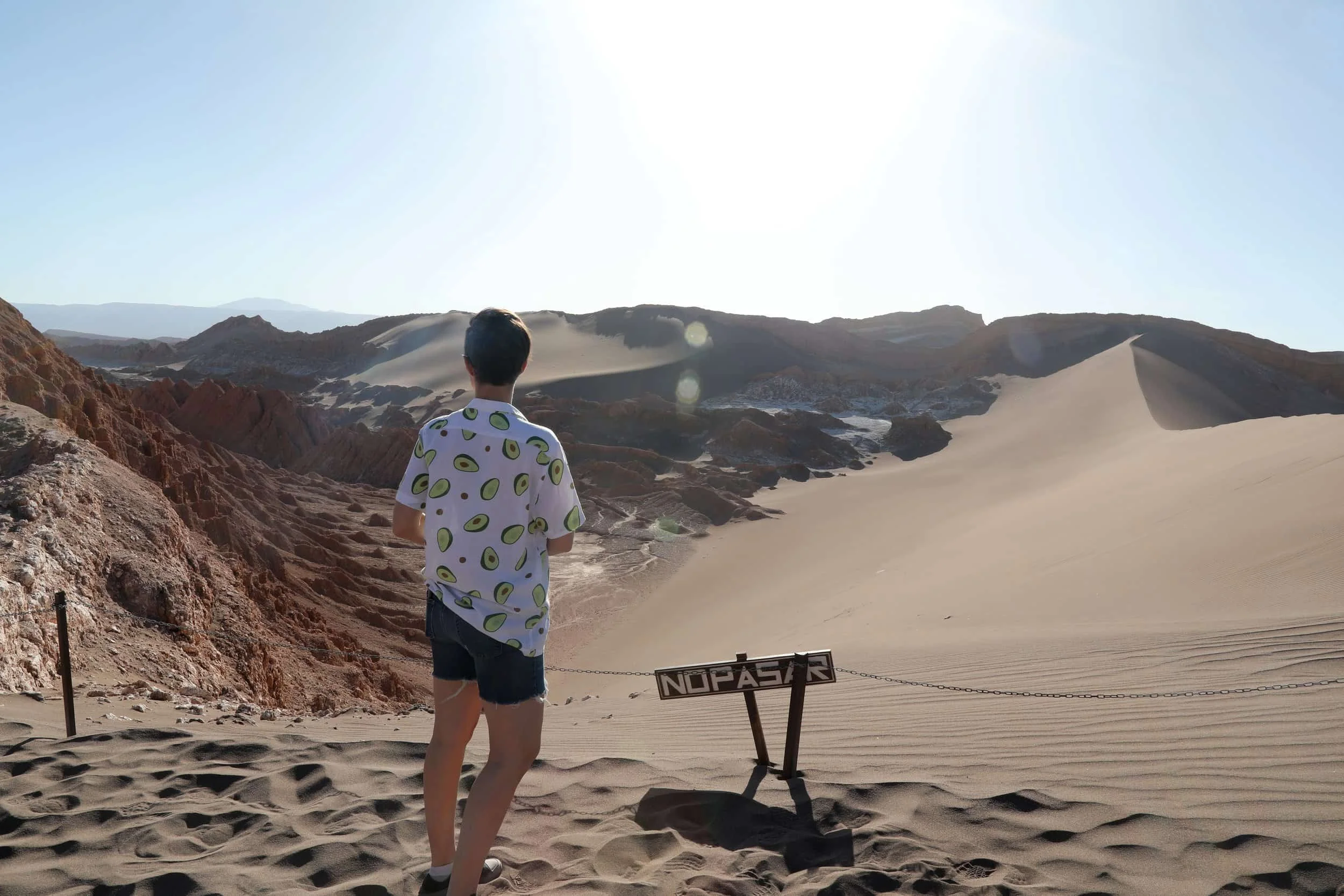
From our desert base, day tours took us through the mineral-rich landscapes of the Altiplanic lagoons, the flamingo-filled waters of Laguna Chaxa and the striking red rock formations of Piedras Rojas. We watched steam rise from the El Tatio geysers at sunrise and explored the sculptural landscapes of Valle de la Luna. But one of the most memorable experiences came after dark, when an Atacama Desert stargazing tour introduced us to the Southern Hemisphere's night sky. Learning about the constellations and observing the Moon through a telescope gave us an entirely different perspective on this extraordinary desert.
Next, we traveled south through Punta Arenas on our way to Torres del Paine National Park, where we stayed surrounded by Patagonia's dramatic mountains, glaciers, waterfalls and turquoise lakes.
Our final destination was Chiloé Island, where we based ourselves in Castro. Its colorful palafitos (traditional stilt houses), historic wooden churches and rich island folklore offered a fascinating contrast to everything we'd experienced before.
From desert skies and volcanic landscapes to glacial valleys and coastal villages, two weeks in Chile revealed just how much variety one country can hold.
Explore
Here’s where the journey will take us.
Experience | Guided astronomy & stargazing tour
Location | San Pedro de Atacama, Chile
Best Time | April–September, ideally around a new moon
Duration | Approximately 2–4 hours, usually after dark
Activity Level | Easy, with some walking on uneven desert terrain
Cost | Approximately CLP 30,000–65,000 ($35–$70 USD); prices vary by operator
What to Bring | Warm layers, water & a camera or smartphone
Read On | San Pedro de Atacama’s Serene Desert Magic
Day Trips | Flamingos in Pink, Rusty Red Rocks & the Sapphire Lagoons of the Atacama, Steam, Sunlight & Surreal Silence at El Tatio & San Pedro de Atacama Desert Tours: Valle de la Luna
Travel More | Chile Travel Guides
Stargazing in the Atacama Desert: A Night Beneath a Million Stars
As darkness settles over the Atacama Desert, the night sky reveals an extraordinary display of stars, constellations and distant galaxies. Far from the lights of town, the Milky Way stretches across the sky, and the desert's stillness makes the experience feel even more remarkable.
Among the many Atacama Desert tours, stargazing offers something entirely different — a chance to explore the universe through powerful telescopes, learn the stories behind the constellations and discover just how much is hidden in the night sky.
If you're planning your own stargazing experience, you'll find everything you need to know about when to go, where to stay and booking a tour in the Travel Essentials section at the end of this guide.
Why Chile Is One of the World's Best Places for Stargazing
Northern Chile is home to some of the clearest night skies on Earth, making the Atacama Desert one of the world's premier destinations for astronomy. Its combination of high altitude, exceptionally dry air and minimal light pollution creates remarkable conditions for observing stars, planets and distant galaxies. With so little atmospheric moisture to obscure the view, celestial objects can appear extraordinarily sharp and bright.
The Atacama's geography plays an important role. Sheltered between the Andes and the coastal mountain ranges, much of the region receives very little rainfall and experiences an unusually high number of clear nights. These conditions have attracted some of the world's most advanced astronomical facilities, including the Atacama Large Millimeter/submillimeter Array (ALMA) and the Paranal Observatory, home to the European Southern Observatory's Very Large Telescope.
For travelers, the experience is just as fascinating without access to a professional observatory. From San Pedro de Atacama, guided stargazing tours introduce visitors to the Southern Hemisphere's constellations, the Milky Way and celestial objects often difficult to appreciate from more populated regions. It's a rare opportunity to see the night sky with extraordinary clarity while learning more about the science and stories behind what you're seeing.
Best Stargazing Spots in Chile: Observatories & Dark Skies
Chile's extraordinary night skies aren't limited to San Pedro de Atacama. Across the country's arid north, professional observatories study distant galaxies and the origins of the universe, while smaller astronomical centers introduce visitors to the constellations, planets and stories behind the stars.
If you're interested in exploring astronomy beyond a typical evening tour, several destinations are worth knowing about. Some offer guided telescope viewing, while others are important scientific facilities with more limited public access.
San Pedro de Atacama & the Chajnantor Plateau
San Pedro de Atacama is one of Chile's most accessible bases for stargazing, with guided nighttime excursions that combine astronomy, telescope observations and the remarkable darkness of the surrounding desert.
Farther into the Andes, the Chajnantor Plateau sits at approximately 16,400 feet (5,000 meters) and is home to the Atacama Large Millimeter/submillimeter Array (ALMA). Rather than a conventional optical telescope, ALMA uses an array of enormous antennas to detect millimeter and submillimeter wavelengths, revealing cold gas, dust and regions where stars and planets form.
It's a fascinating example of how astronomers can study parts of the universe that visible-light telescopes cannot easily reveal. ALMA's high-altitude antenna site is closed to tourists, although special visits to its lower-elevation Operations Support Facility are occasionally offered.
The region also hosted the Atacama Cosmology Telescope, a 20-foot (6-meter) instrument on Cerro Toco that operated from 2007 to 2022. Its observations of the cosmic microwave background — faint radiation left over from the early universe — helped scientists investigate the universe's structure, composition and evolution.
Paranal Observatory — The Science & Architecture of Astronomy
Located on Cerro Paranal at approximately 8,645 feet (2,635 meters), Paranal Observatory is one of the world's leading astronomical research facilities. Operated by the European Southern Observatory, it houses the Very Large Telescope (VLT), a system of four enormous optical and infrared telescopes that can work together to study exceptionally distant and faint celestial objects.
The architecture is almost as compelling as the science. Massive telescope enclosures rise from the barren mountaintop, while the observatory's partially subterranean residence creates a sheltered environment for researchers working in one of Earth's harshest landscapes.
Paranal offers advance-booked public visits on selected dates, generally during daylight hours. These are opportunities to learn about the facility rather than conventional nighttime stargazing experiences.
Las Campanas Observatory — Exploring the Distant Universe
Farther south, near the southern edge of the Atacama Desert, Las Campanas Observatory has been an important center for astronomical research since 1969. Operated by Carnegie Science, the facility benefits from exceptionally dark skies and stable atmospheric conditions.
Its twin Magellan telescopes, each with a 21-foot (6.5-meter) primary mirror, are used to study everything from distant galaxies to the evolution of stars. Las Campanas is also the future home of the Giant Magellan Telescope, an ambitious project designed to bring even greater detail to astronomical observations.
The observatory offers limited daytime visits by arrangement but it isn't a typical public stargazing destination. Its location also makes it a separate journey from San Pedro de Atacama rather than a convenient excursion from town.
Elqui Valley & Observatorio del Pangue
South of the Atacama's most famous desert landscapes, the Elqui Valley is another of Chile's outstanding stargazing regions. Surrounded by dry mountains and known for its vineyards, pisco production and clear skies, the valley offers a different atmosphere from the remote high-altitude landscapes around San Pedro.
Near the town of Vicuña, Observatorio del Pangue offers guided astronomy experiences using powerful telescopes. Unlike the large scientific observatories, its programs are designed for visitors who want to spend an evening learning about the night sky and observing celestial objects firsthand.
The Elqui Valley is especially appealing if you'd like to combine astronomy with local culture, small towns and a more relaxed countryside stay.
Indigenous Astronomy & Andean Perspectives
Astronomy in northern Chile isn't limited to modern telescopes. Indigenous Andean traditions have long connected the night sky with seasonal cycles, agriculture, animals and the surrounding landscape.
Some cultural astronomy experiences around San Pedro de Atacama introduce visitors to these perspectives, including the interpretation of dark shapes within the Milky Way rather than only the bright stars that form Western constellations.
An ethno-astronomical experience can offer a valuable complement to a scientific stargazing tour, particularly when led by local guides who can explain the traditions and cultural context behind the stories.
Piedras Rojas & the High-Altitude Desert
For a dramatic landscape rather than a formal observatory, Piedras Rojas is one of the Atacama's most striking locations. At approximately 13,000 feet (3,960 meters), its rust-colored rock formations contrast with pale salt flats, mineral-rich water and the surrounding volcanic peaks.
The region's altitude and remoteness create remarkable conditions for dark skies but Piedras Rojas is primarily a protected daytime sightseeing destination, not an established nighttime stargazing site. Access restrictions, altitude and difficult driving conditions make it unsuitable for an independent after-dark excursion.
For travelers staying in San Pedro de Atacama, a guided astronomy tour at a designated nighttime viewing location is the more practical way to experience the desert sky.
What to Expect on an Atacama Desert Stargazing Tour
Most guided stargazing experiences around San Pedro de Atacama take place after dark, away from the town's lights, where the desert's exceptionally clear skies create ideal conditions for observing the stars. Tours commonly include an introduction to astronomy, guided telescope viewing and opportunities for night-sky photography, with some also offering warm drinks and transportation from town.
Experiences vary by operator, so it's worth checking the duration, group size, equipment and whether photographs are included before booking. For our evening in the desert, the combination of local knowledge, powerful telescopes and a remarkably clear sky made the experience especially memorable.
Begin Your Celestial Journey Beneath the Atacama Night Sky
Around 9 p.m., we climbed into the tour van and headed out of San Pedro de Atacama, leaving the town's lights behind. After arriving, we followed our guide, Margarita, along a narrow path to her small observatory — a modest space where she lives, works and shares her knowledge of the night sky.
A semicircle of benches faced two telescopes, one relatively small and the other considerably larger. As we settled in beneath the stars, Margarita opened with a simple question: “Why stargaze in Chile?” Then she pointed toward the sky.
Beyond the exceptional viewing conditions, there's another reason stargazing here feels so different: we were looking at the universe from the Southern Hemisphere. Some familiar constellations were still visible, while others had disappeared below the horizon, replaced by star patterns we rarely encounter farther north.
Margarita explained that the Southern Hemisphere offers a particularly striking view toward the center of the Milky Way, where dense star fields, glowing nebulae and distant clusters create an extraordinary concentration of celestial objects. It's not that the southern sky necessarily contains more stars but its view of the galaxy's bright central regions can be especially impressive.
Among the southern sky's remarkable sights are the Southern Cross (Crux), the constellation Vela, the colorful Jewel Box star cluster, the enormous Omega Centauri globular cluster and the Carina Nebula, home to the extraordinary star Eta Carinae. Each reveals something different about our galaxy, from groups of ancient stars to vast clouds of gas where new stars are forming.
Standing beneath that sky, listening to Margarita connect the constellations with the larger story of the universe, was a fascinating introduction to what we were about to explore through the telescopes.
Discover What Lies in Atacama's Night Sky
Margarita reached into her bag and pulled out a laser pointer, sending a thin green beam across the darkness. With each movement, she connected seemingly scattered stars into recognizable patterns, tracing constellations and explaining the remarkable objects hidden among them. What initially looked like an endless collection of tiny lights gradually became a map of the southern sky.
She began with the Southern Cross (Crux), one of the Southern Hemisphere's most recognizable constellations and a symbol found on the flags of Australia and New Zealand. Nearby was Vela, whose name means sails in Latin — a reference to the ancient constellation Argo Navis, which represented the ship of Jason and the Argonauts.
Tucked close to the Southern Cross is the Jewel Box Cluster, a collection of young stars whose contrasting colors inspired its name. Through a telescope, brilliant blue stars mingle with warmer orange and red tones, resembling a handful of gemstones scattered across black velvet. The cluster lies approximately 6,400 light-years from Earth and is only about 16 million years old — remarkably young by astronomical standards.
Margarita also introduced us to Omega Centauri, an enormous globular cluster in the constellation Centaurus. Unlike the relatively young stars of the Jewel Box, Omega Centauri contains some of the Milky Way's oldest stars, many billions of years old. Roughly 10 million stars are packed into this gravitationally bound collection, located about 17,000 light-years away. It's the largest and brightest globular cluster in our galaxy, and astronomers suspect it may even be the surviving core of a small galaxy absorbed by the Milky Way.
Then came the extraordinary Carina Nebula, a vast region of gas and dust where stars are born. Spanning hundreds of light-years, it contains enormous, luminous stars, including the famously unstable Eta Carinae. This massive stellar system experienced a dramatic eruption in the 19th century and remains an important subject of astronomical research. Scientists expect its most massive star to eventually end its life in a supernova, although no one knows when that will happen. It's fascinating to think that something appearing so peaceful from Earth is actually a place of tremendous energy and change.
As Margarita continued tracing the sky, she introduced us to some more familiar celestial landmarks. The Pleiades, also called the Seven Sisters, form a compact cluster in the constellation Taurus. In Greek mythology, the sisters were daughters of Atlas and Pleione, transformed into stars. Although only a handful are easily distinguished with the naked eye, the cluster contains more than a thousand known stars, many of which become visible through binoculars and telescopes.
Nearby, Orion's Belt forms its unmistakable straight line of three bright stars: Alnitak, Alnilam and Mintaka. Known by different names across cultures, the belt is one of the easiest patterns to recognize in the night sky. Its appearance during the Southern Hemisphere's summer also illustrates how the constellations change with the seasons.
Other brilliant stars punctuate the darkness. Sirius, the Dog Star, is the brightest star in Earth's night sky, while Canopus, in the constellation Carina, is the second brightest. Alpha and Beta Centauri help point toward the Southern Cross, and Antares, a red supergiant in Scorpius, stands out for its distinctive reddish-orange glow.
Beyond the individual stars, the Magellanic Clouds are among the southern sky's most fascinating sights. Appearing as faint, misty patches to the naked eye, these are actually two neighboring dwarf galaxies — the Large and Small Magellanic Clouds — located far beyond the stars of our own Milky Way. Their soft appearance disguises enormous collections of stars, gas and dust.
And then there's the Milky Way itself, stretching across the desert sky like a pale, luminous river. What looks like a continuous band of light is actually the combined glow of countless distant stars, interspersed with dark clouds of interstellar dust. Some of those darker regions are just as interesting as the bright ones, concealing stars behind thick concentrations of gas and dust.
From the Southern Hemisphere, particularly during the months when the galactic center is visible at night, we can look toward the Milky Way's densely populated central regions. The concentration of stars, nebulae and dark dust lanes makes this part of the sky especially dramatic.
Standing in the desert with Margarita's laser moving from one constellation to another, I began to appreciate just how much was happening overhead. Every point of light had a different story — some stars were relatively young, others had existed for billions of years and some of the faintest objects weren't individual stars at all, but entire galaxies.
What had first appeared to be a beautiful night sky was suddenly something far more complicated, ancient and fascinating.
Peer Through Powerful Telescopes & Discover the Moon
After learning to recognize the constellations, it was time to take a closer look. Margarita adjusted the two telescopes with the confidence of someone who knew exactly where to find each celestial object. One by one, we stepped forward to peer through the eyepieces, discovering how different the night sky looked when individual points of light became something more.
Some objects appeared sharp and distinct, while others were faint, almost cloudlike shapes. Margarita explained that the light reaching our eyes had traveled enormous distances, sometimes for thousands or millions of years. Looking through a telescope isn't just looking farther into space — it's also looking back in time.
One of the most fascinating parts of the evening was learning about the life cycle of stars, from their beginnings inside enormous clouds of gas and dust to the final stages of their evolution.
How Are Stars Born?
Stars begin forming inside dense regions of nebulae, vast clouds of interstellar gas and dust. When gravity causes part of a cloud to collapse, material gathers into a growing central object called a protostar. As more matter falls inward, its core becomes increasingly hot and dense.
Eventually, if the forming star has enough mass, its core reaches temperatures high enough for hydrogen fusion to begin. This marks the beginning of a star's long period of relatively stable life.
Some of the remaining gas and dust can form a rotating disk around the young star, providing the raw materials from which planets, asteroids and other objects may eventually develop.
Young stars can also produce powerful jets of material that shoot outward from their poles. These jets interact with surrounding gas, sometimes creating glowing structures known as Herbig–Haro objects.
The Orion Nebula, approximately 1,350 light-years from Earth, is one of the best-known stellar nurseries. It contains hundreds of young stars and developing stellar systems, offering astronomers an opportunity to study how stars and planets form.
Ancient Stars & the Life Cycle of the Universe
At the other end of the spectrum are some of the universe's oldest stars, formed billions of years ago when galaxies were still taking shape.
The universe itself is approximately 13.8 billion years old, and astronomers have identified stars whose estimated ages approach that extraordinary timescale.
Scientists study stellar ages using several clues, including chemical composition, mass, brightness, temperature and evolutionary stage. Many ancient stars contain relatively few heavy elements because they formed before earlier generations of stars had enriched the universe with those materials.
A star's color also tells us something important, although not necessarily its age. Blue stars generally have hotter surfaces, while red stars are cooler. Massive blue stars often burn through their fuel relatively quickly, whereas smaller stars can survive for billions or even trillions of years.
It's remarkable to think that the faint light reaching a telescope may have begun its journey long before Earth existed in anything resembling its present form.
A Closer Look at the Moon
Of everything we observed that evening, the Moon was one of the most unforgettable sights.
Earth's only natural satellite orbits at an average distance of approximately 238,855 miles (384,400 km). Its gravity is about one-sixth of Earth's, and its surface preserves a record of billions of years of impacts, volcanic activity and geological change.
The darker patches visible from Earth are known as lunar maria, enormous plains formed by ancient volcanic eruptions. The brighter highlands are heavily cratered, revealing the Moon's long history of collisions with asteroids and other objects.
Although we see the Moon change through its familiar phases, those changes are simply the result of viewing different portions of its sunlit half as it orbits Earth.
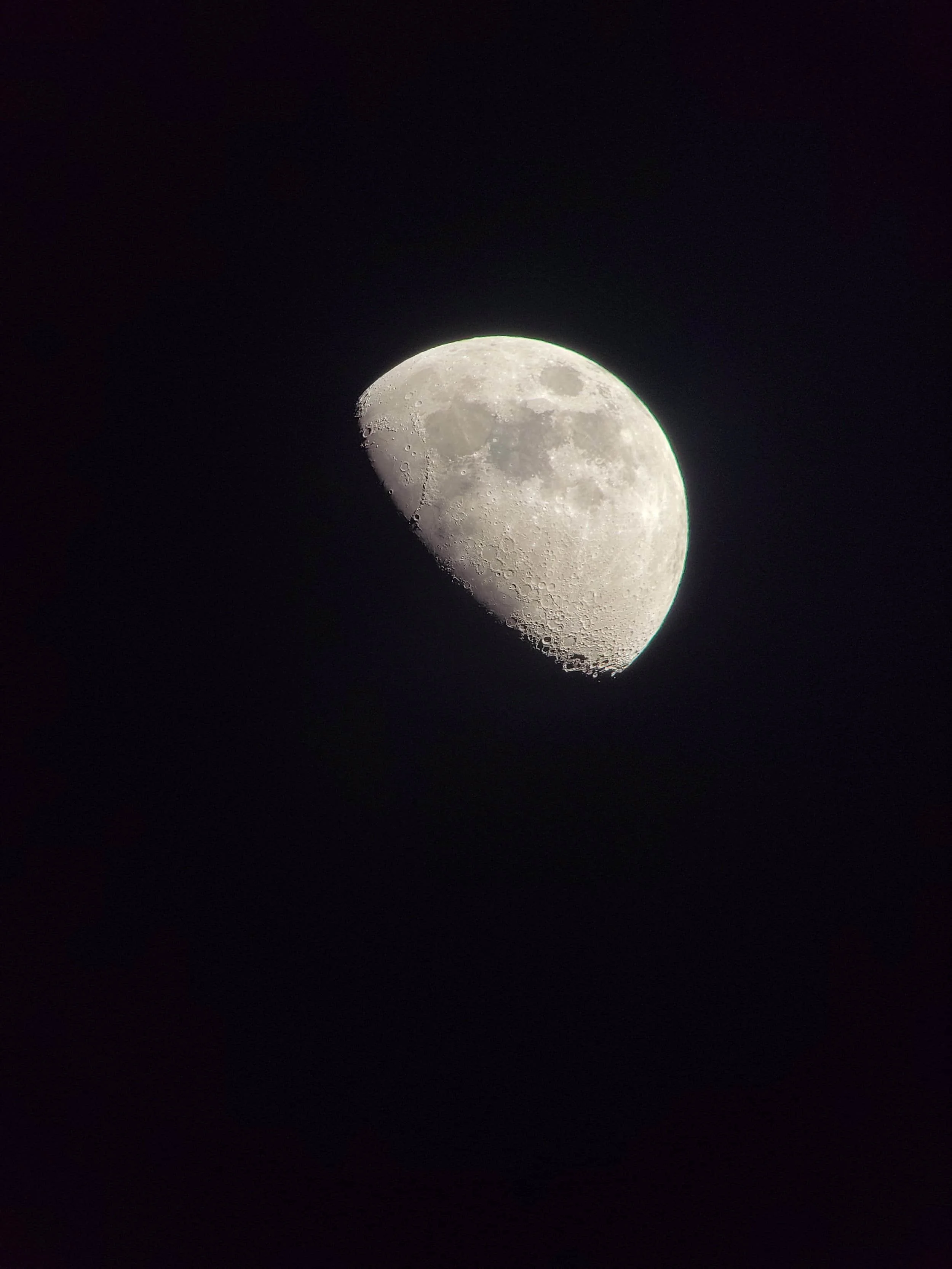
Through Margarita's telescope, the lunar surface came into astonishing focus. Craters appeared with sharply defined edges, shadows revealed the contours of the landscape and the familiar Moon suddenly looked like an entirely different place.
Margarita helped us position our phones against the telescope's eyepiece to capture photographs of what we were seeing. The images weren't perfect but that was part of their appeal. Being able to photograph the Moon through a telescope, with its craters and surface details visible, was something I hadn't expected to experience so vividly.
Standing in the cold desert air, moving between distant celestial objects and the familiar face of our own Moon, I was struck by how much there was to discover. Some of what we saw was ancient, some was still evolving and all of it existed on a scale that's difficult to comprehend.
It was a wonderful reminder that even the most familiar things can look extraordinary when you see them from a different perspective.
A Portrait Beneath the Stars & Hot Chocolate to Finish
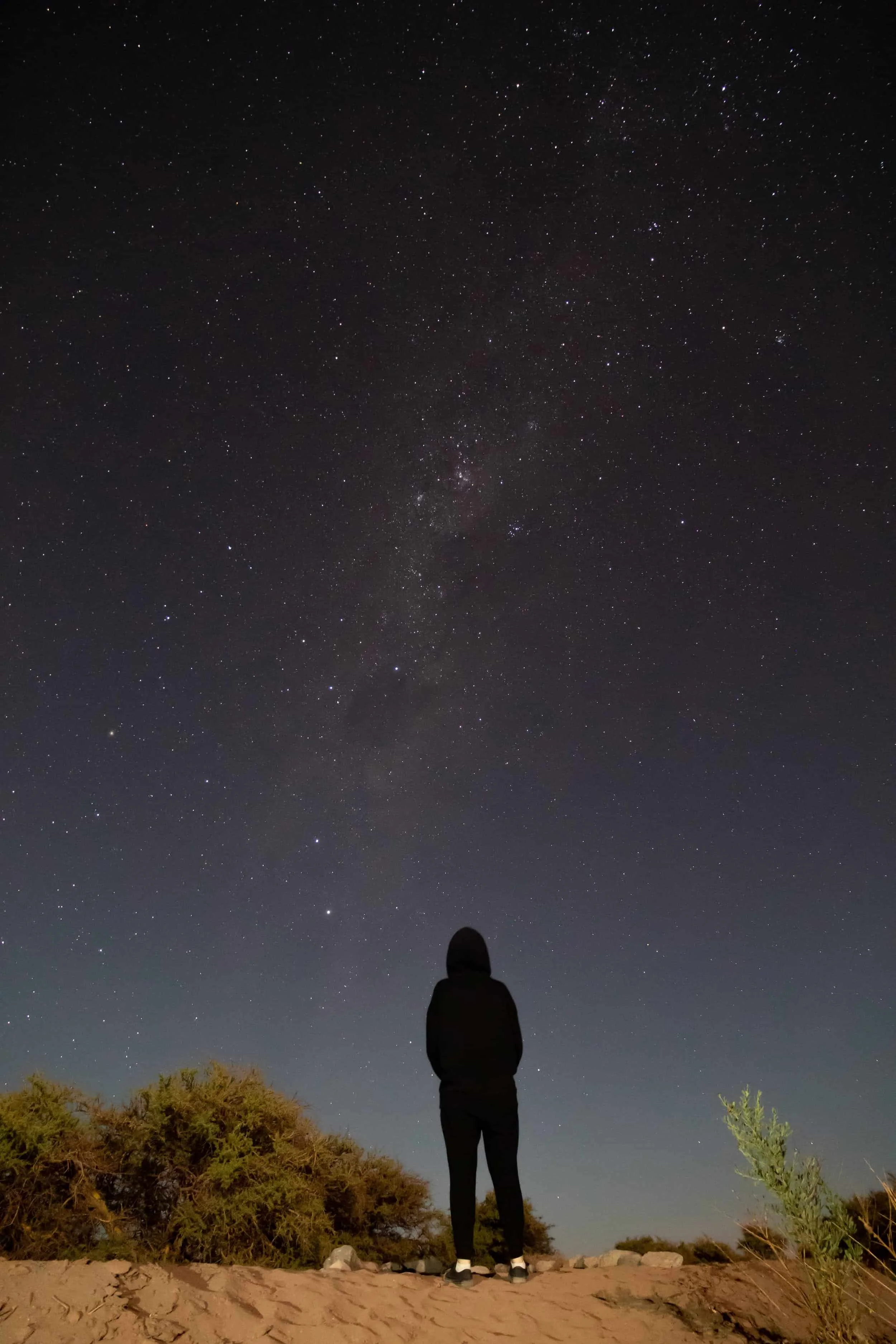
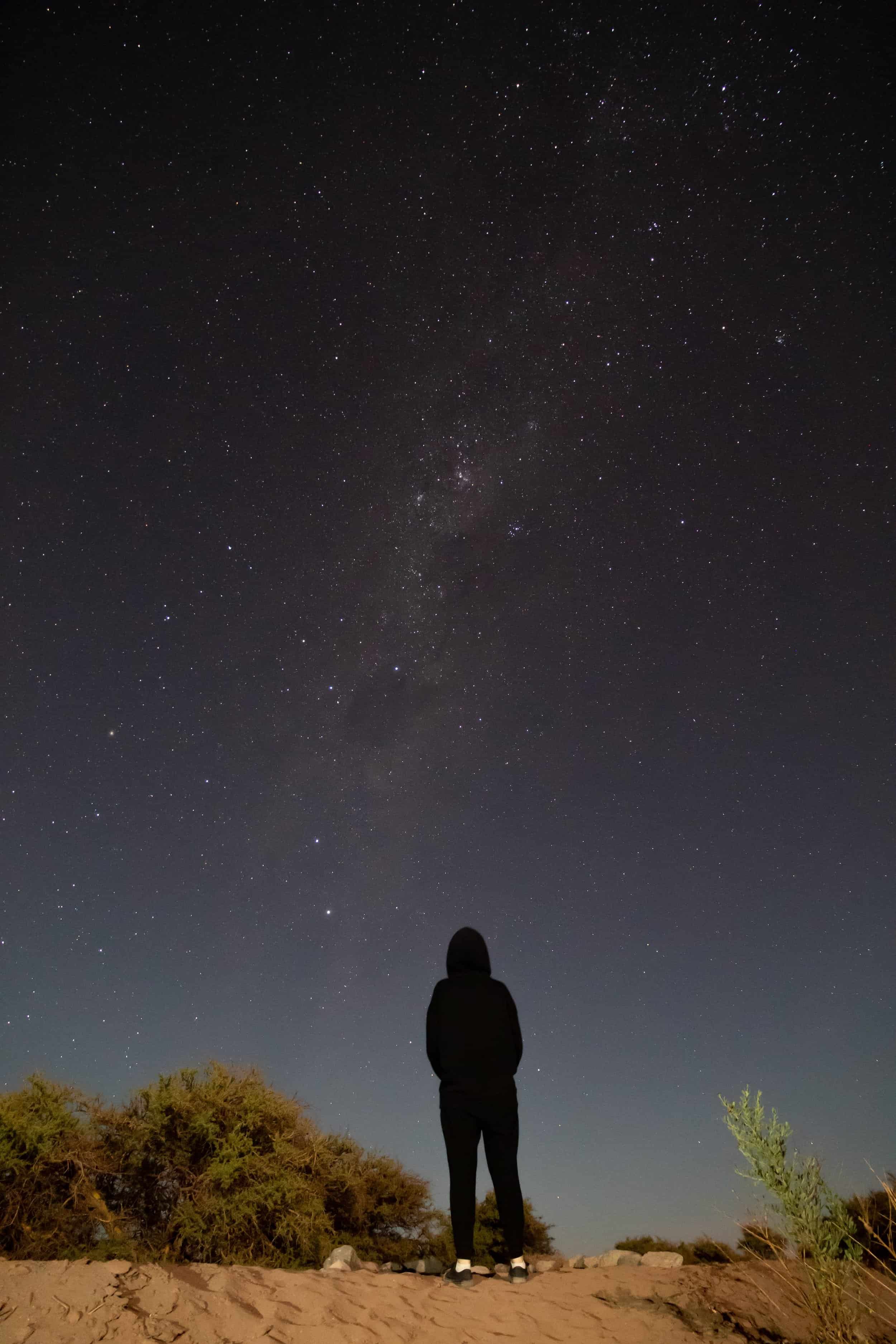
Before the evening ended, Margarita arranged for each of us to have a photograph taken beneath the Atacama's extraordinary night sky. Using a long exposure to capture the stars and a soft light to illuminate us in the foreground, she created portraits that seemed to place us right in the middle of the Milky Way. The resulting photograph was one of my favorite souvenirs from Chile — a beautiful reminder of just how many stars were visible that night.
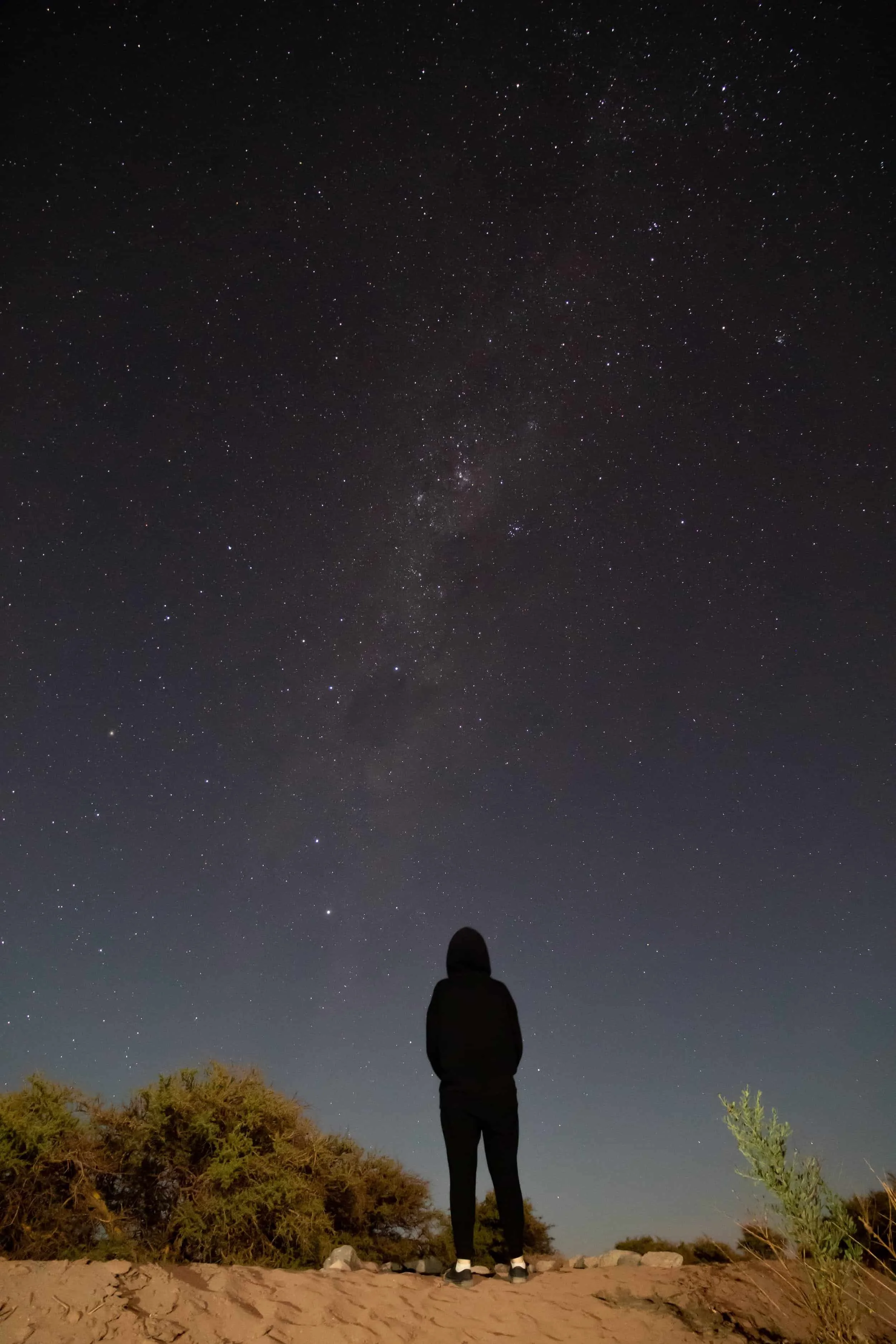
To finish the experience, Margarita invited us to a small table filled with snacks and steaming mugs of hot chocolate. Wrapped in blankets against the desert chill, we settled in while a nearby screen displayed projections of the night sky, revisiting some of the constellations and celestial stories we'd learned throughout the evening.
It was a wonderfully relaxed way to end one of my favorite Atacama Desert tours. After hours spent learning about distant galaxies, ancient stars and the Moon's cratered surface, sitting together with something warm to drink felt like a fitting return to Earth.
Around midnight, we made our way back to our accommodations in San Pedro de Atacama, tired from the late evening but still thinking about everything we'd seen.
There's something remarkable about standing beneath a sky so full of stars that it changes your sense of scale. The distances are almost impossible to comprehend, yet for a few hours, Margarita made the universe feel a little more familiar.
My Bibimbap Moment
Every destination adds another ingredient to our life's recipe, and sometimes the world feels entirely different after dark. Far beyond the lights of San Pedro de Atacama, the desert became almost completely black, opening onto a sky so dense with stars that it was difficult to believe I was still looking up from Earth. Between learning the stories of the Southern Hemisphere sky, peering through powerful telescopes and warming my hands around a hot drink, the evening felt wonderfully removed from everything familiar. Here's the ingredient this extraordinary night added to my Bibimbap Life.
Today’s Bibimbap Recipe
🥢 Flavor: Celestial
🌿 Ingredient: Awe
❤️ Best Memory: Looking into the blackness of the Atacama sky
🎒 Take With You: Every once in a while, something reminds us just how enormous the world is — and how wonderfully small we are within it.
When I think back on that night, I remember how dark it really was. Without the glow of a city around us, the sky seemed to take over everything and for a few hours it was easy to forget the world below it. Looking through the telescope and seeing Jupiter, lunar craters and distant clouds of light felt almost unreal but the most memorable part may have been stepping away from the equipment and looking up with nothing between me and the stars. We stood there in the desert cold with warm cups in our hands, each of us a tiny figure beneath an enormous sky. It was one of those experiences that leaves you quiet for a while afterward.
Atacama Desert Stargazing Travel Essentials
Planning an Atacama Desert stargazing tour is relatively straightforward but a few details can make a big difference to your experience. From choosing the right time of year and finding a comfortable base in San Pedro de Atacama to preparing for the surprisingly cold desert nights, it's worth knowing what to expect before heading out beneath the stars.
These travel essentials cover the practical details to help you make the most of your time in the Atacama, whether stargazing is your main reason for visiting or one of several adventures you're planning in northern Chile.
When to Go
The Atacama Desert offers excellent stargazing opportunities year-round, thanks to its exceptionally dry climate, high altitude and generally clear skies. For particularly impressive views of the Milky Way's bright central regions, April through September is a great time to visit, although the best conditions depend on the weather and moon phase.
Moon Cycle: One of the most important considerations when booking an Atacama Desert stargazing tour is the lunar calendar. Aim for a new moon or the days surrounding it, when darker skies make faint stars, nebulae and the Milky Way easier to see. A bright full moon can wash out much of the night sky, and some operators adjust or suspend tours around this phase. However, if you're especially interested in observing the Moon through a telescope, a partially illuminated Moon can reveal its craters and surface features beautifully.
Time of Year: Southern Hemisphere winter (June through August) brings longer nights and excellent opportunities to view the Milky Way's galactic center but temperatures can drop below freezing after dark. Summer (December through February) offers milder evenings and shorter nights, with a greater chance of cloud cover and occasional rainfall associated with the Altiplanic winter. Spring and autumn can provide a comfortable balance of viewing conditions and temperatures.
How to Get There
San Pedro de Atacama is the main base for exploring northern Chile's Atacama Desert and the starting point for most guided stargazing tours. The easiest way to reach this small desert town is to fly into Calama, then continue by road through the dramatic landscapes of the high desert.
Fly to Santiago: Most international visitors arrive at Arturo Merino Benítez International Airport (SCL) in Santiago, Chile's capital.
Fly to Calama: From Santiago, take a domestic flight of approximately two hours to El Loa Airport (CJC) in Calama, the closest major airport to San Pedro de Atacama.
Transfer to San Pedro de Atacama: From Calama Airport, it's approximately 62 miles (100 km) to San Pedro, usually a 1.5-hour drive. Shared airport shuttles, private transfers and rental cars are available. Booking a shuttle in advance is often the simplest option if you don't plan to drive.
Getting to Your Stargazing Tour: Most Atacama Desert stargazing tours depart from San Pedro de Atacama after dark and travel outside town to locations with minimal artificial light. Many operators provide transportation from a designated meeting point or your accommodation, although arrangements vary. Our tour began with an evening van transfer to Margarita's small observatory, where we spent the night exploring the southern sky.
You generally won't need a rental car for a guided stargazing experience but be sure to confirm your tour's meeting location, departure time and return transportation when booking.
Where to Stay
San Pedro de Atacama is the best base for exploring the Atacama Desert and joining its many stargazing tours. Accommodation ranges from simple guesthouses and intimate boutique hotels to peaceful desert retreats. Staying near the town center makes it easy to reach restaurants, shops and tour meeting points, particularly when returning late at night. Properties a little farther out often offer more space, quieter surroundings and a welcome escape from the daytime heat.
Where I Stayed in San Pedro de Atacama
For a Peaceful Desert Retreat — Casa Solcor Boutique Bed & Breakfast
We stayed at Casa Solcor Boutique Bed & Breakfast, just outside the center of San Pedro de Atacama, and it was nearly perfect. The peaceful atmosphere, lovely pool, comfortable lounging areas and delicious breakfast made it a wonderful place to unwind between excursions. Town was only about a 10–15-minute walk away, although the desert heat made that short distance feel considerably longer during the day. For us, the tranquility and space were well worth it.
Where I'd Stay in San Pedro de Atacama
If I were planning another visit, these are a few places I'd consider for their thoughtful design, inviting atmosphere and convenient locations. Each offers something slightly different, from intimate boutique accommodations to a peaceful retreat after a day — or night — exploring the desert.
For a Quiet Boutique Stay — Hotel Pascual Andino
A welcoming boutique hotel with just 10 rooms, located one block from San Pedro's main street. Adobe-style walls, warm wood finishes and private patios reflect the region's architectural character, while a seasonal pool and included breakfast make it a comfortable place to recharge. It's an appealing option if you prefer smaller accommodations while keeping restaurants and tour meeting points within easy walking distance.
For Design & Desert Atmosphere — Hotel Desértica
One of San Pedro de Atacama's more distinctive design-focused stays, Hotel Desértica occupies a former Atacameño orchard just a short walk from the town center. Its circular guest rooms take inspiration from traditional local construction, creating an interesting relationship between architecture and landscape. With a pool, inviting outdoor lounges and an on-site restaurant, it's particularly appealing for travelers who appreciate thoughtful design and a peaceful place to return to after exploring the desert.
Additional Options
For a Historic Boutique Splurge — Hotel Terrantai
Located in the historic center of San Pedro de Atacama, Hotel Terrantai occupies a restored 19th-century property that celebrates the region's traditional architecture. Adobe, stone, wood and local craftsmanship give the interiors a strong sense of place, while contemporary comforts complement the building's historic character. Its central location is especially convenient for walking to restaurants and returning after an evening stargazing tour.
Prefer a Place of Your Own in San Pedro?
A private apartment, casita or vacation rental can be a great alternative, especially if you're staying several days or prefer a little more independence. Having your own kitchen and outdoor space can make it easier to settle into the slower rhythm of desert life between excursions. Look for somewhere within walking distance of the town center if you won't have a rental car, and confirm transportation arrangements for late-night tours.
How to Get Around
San Pedro de Atacama is small and easy to explore on foot, with most restaurants, shops and tour operators concentrated around the town center. Just keep in mind that the desert sun, dry air and elevation can make even a 10–15-minute walk feel longer than expected, particularly during the hottest part of the day.
For exploring beyond town, guided Atacama Desert tours are often the most convenient option, with transportation typically included to destinations such as Valle de la Luna, El Tatio Geysers and the Altiplanic Lagoons. Stargazing tours generally provide evening transfers to observing locations outside town, so there's usually no need to navigate unfamiliar desert roads after dark. Be sure to confirm your pickup and return arrangements when booking.
Renting a car offers more flexibility for independent exploration, although some destinations involve long distances, unpaved roads and high elevations. Bicycles are another popular option for nearby attractions but the heat, limited shade and altitude are worth considering.
Unless you're planning extensive independent excursions, you can comfortably explore San Pedro de Atacama without a rental car, making it an easy base for both daytime adventures and nighttime stargazing.
How Long to Stay
An Atacama Desert stargazing tour typically lasts around 2–3 hours, with most excursions departing San Pedro de Atacama after dark and returning late in the evening. Our experience began around 9 p.m. and ended close to midnight, making it easy to combine with a daytime excursion, provided you leave yourself enough time to rest.
For the wider Atacama Desert, I'd recommend spending at least 3–4 full days in San Pedro de Atacama. This gives you time to explore Valle de la Luna, El Tatio Geysers, Piedras Rojas and the Altiplanic Lagoons, along with an evening of stargazing, without rushing through every experience.
If your schedule allows, five days is even better. The extra time provides a more relaxed pace, particularly with early-morning departures, long drives and the need to adjust to higher elevations. It also gives you some flexibility to reschedule your stargazing tour if clouds or an unexpectedly bright Moon interfere with viewing conditions.
Tours & Day Trips
San Pedro de Atacama is an excellent base for exploring northern Chile, with guided excursions ranging from high-altitude lagoons and steaming geysers to some of the world's most spectacular night skies. Local operators offer a wide variety of Atacama Desert tours, making it easy to combine daytime adventures with an evening of stargazing without needing to rent a car.
You can book excursions through agencies in downtown San Pedro or reserve online before arriving. I found booking locally convenient, particularly when arranging several tours over a few days. Operators such as Turismo Gato Andino and Horizons Turismo are worth checking for available excursions, while astronomy-focused operators such as SPACE Obs offer more specialized experiences.
💡 My Tip | If stargazing is a priority, I'd recommend booking your astronomy tour early in your stay. That gives you some flexibility to reschedule if clouds interfere with viewing conditions. During busy travel periods, reserve ahead rather than relying on last-minute availability. Check the moon phase, group size, telescope access, photography options and transportation arrangements before choosing a tour.
Types of Stargazing Tours & How to Choose
Not all Atacama Desert stargazing tours are the same. Some focus on scientific astronomy and telescope viewing, while others explore Indigenous interpretations of the night sky or specialize in photographing the Milky Way. Most guided evening experiences last approximately 2.5–3.5 hours, although inclusions vary by operator.
Standard Astronomy & Telescope Tours: These are the classic stargazing experiences, typically led by knowledgeable astronomy guides who introduce the constellations, explain celestial objects and provide opportunities to observe the Moon, planets, star clusters and nebulae through telescopes. Some include warm drinks and night-sky portraits. This is the type of experience I'd recommend for a first visit.
Andean Cosmovision Tours: These experiences explore the cultural significance of the night sky through Indigenous Andean traditions. Rather than focusing exclusively on Western constellations, some introduce the dark cloud constellations — recognizable shapes formed by the dark dust lanes within the Milky Way. They're an especially interesting choice for travelers who want to understand the relationship between astronomy, storytelling and local cultural heritage.
Astrophotography Tours: Designed for travelers who want to capture the night sky, these excursions focus on long-exposure photography, camera settings and composition. Some provide professional portraits with the Milky Way as a backdrop, while more specialized workshops teach participants to photograph stars and celestial landscapes using their own equipment.
Scientific Observatory Visits: For astronomy enthusiasts, visits to research facilities offer a different perspective on the science behind the stars. Facilities such as ALMA operate sophisticated instruments designed to study the universe beyond what ordinary optical telescopes can reveal. Public access is restricted and depends on current visitor programs, so check official availability well in advance. These are generally educational daytime visits rather than nighttime telescope tours, and ALMA's high-altitude antenna site is not open for regular tourist visits.
Want to Experience Atacama Desert Stargazing?
Discover guided Atacama Desert stargazing tours from San Pedro de Atacama, including astronomy experiences with powerful telescopes, constellation storytelling and opportunities for night-sky photography. Compare the group sizes, equipment, departure times and inclusions to find the experience that interests you most.
Explore Atacama Desert stargazing tours →
Want to Discover More of the Atacama Desert?
There's plenty to explore beyond the night sky. Watch the El Tatio Geysers steaming at sunrise, discover the dramatic formations of Valle de la Luna, look for flamingos at Laguna Chaxa or visit the colorful landscapes of Piedras Rojas and the Altiplanic Lagoons. Each reveals a different side of the desert's extraordinary geology, wildlife and natural beauty.
What to Bring
Even in one of the driest deserts on Earth, Atacama nights can be surprisingly cold, especially during the Southern Hemisphere winter when temperatures can drop below freezing. Stargazing tours involve standing or sitting outdoors for extended periods, so dressing warmly and bringing a few essentials will make the experience much more comfortable.
Warm Layers: Bring a thermal base layer, fleece or sweater and an insulated jacket. Temperatures can drop quickly after sunset, even following a hot afternoon.
Hat, Gloves & Warm Socks: Particularly important between May and September, when nighttime temperatures can be bitterly cold.
Comfortable Closed-Toe Shoes: Choose sturdy shoes or sneakers suitable for walking along uneven, sandy desert paths.
Camera or Smartphone: Bring your phone for photographs through the telescope or portraits beneath the stars. If you're interested in astrophotography, a camera with manual settings and a tripod can be useful, provided your tour allows personal equipment.
Water & Lip Balm: The desert's extremely dry air can leave you dehydrated, even when it's cold. A reusable water bottle and moisturizing lip balm are worth packing.
Small Backpack: Handy for carrying extra layers and personal belongings while keeping your hands free.
💡 My Tip | Avoid using bright phone screens, camera flashes or white flashlights during your tour, as they interfere with everyone's night vision. A dim red-light setting is much better for preserving your ability to see faint stars. Also, check whether your operator provides blankets, hot drinks or professional photographs — our tour with Margarita included all three, which made the cold evening considerably more enjoyable.
Good to Know
San Pedro de Atacama sits at approximately 7,900 feet (2,400 m) above sea level, so the altitude can take some getting used to, particularly if you're arriving directly from Santiago or another low-elevation destination. Give yourself a day or two to adjust, stay hydrated and avoid overexertion if you're feeling the effects. Most stargazing tours operate at relatively accessible elevations near town but excursions to the Altiplanic Lagoons or El Tatio Geysers take you considerably higher.
Check the language and inclusions before booking your astronomy tour. Some guides offer explanations in both English and Spanish, while others conduct tours primarily in one language. Because so much of the experience involves learning about constellations, galaxies and the stories behind them, having a guide you can comfortably understand makes a real difference. It's also worth confirming whether transportation, telescope viewing, hot drinks and astrophotography are included in the price.
Stargazing is entirely dependent on the night sky cooperating. Even in the famously dry Atacama Desert, clouds, strong winds and bright moonlight can affect visibility. Reputable operators may reschedule or cancel tours when conditions aren't suitable, so check their weather and cancellation policies before booking. If possible, plan your stargazing experience early in your visit to leave room for a second opportunity. And remember that the desert cools dramatically after sunset — even if you've spent the afternoon in shorts, you'll appreciate those extra layers once you're standing beneath the stars.
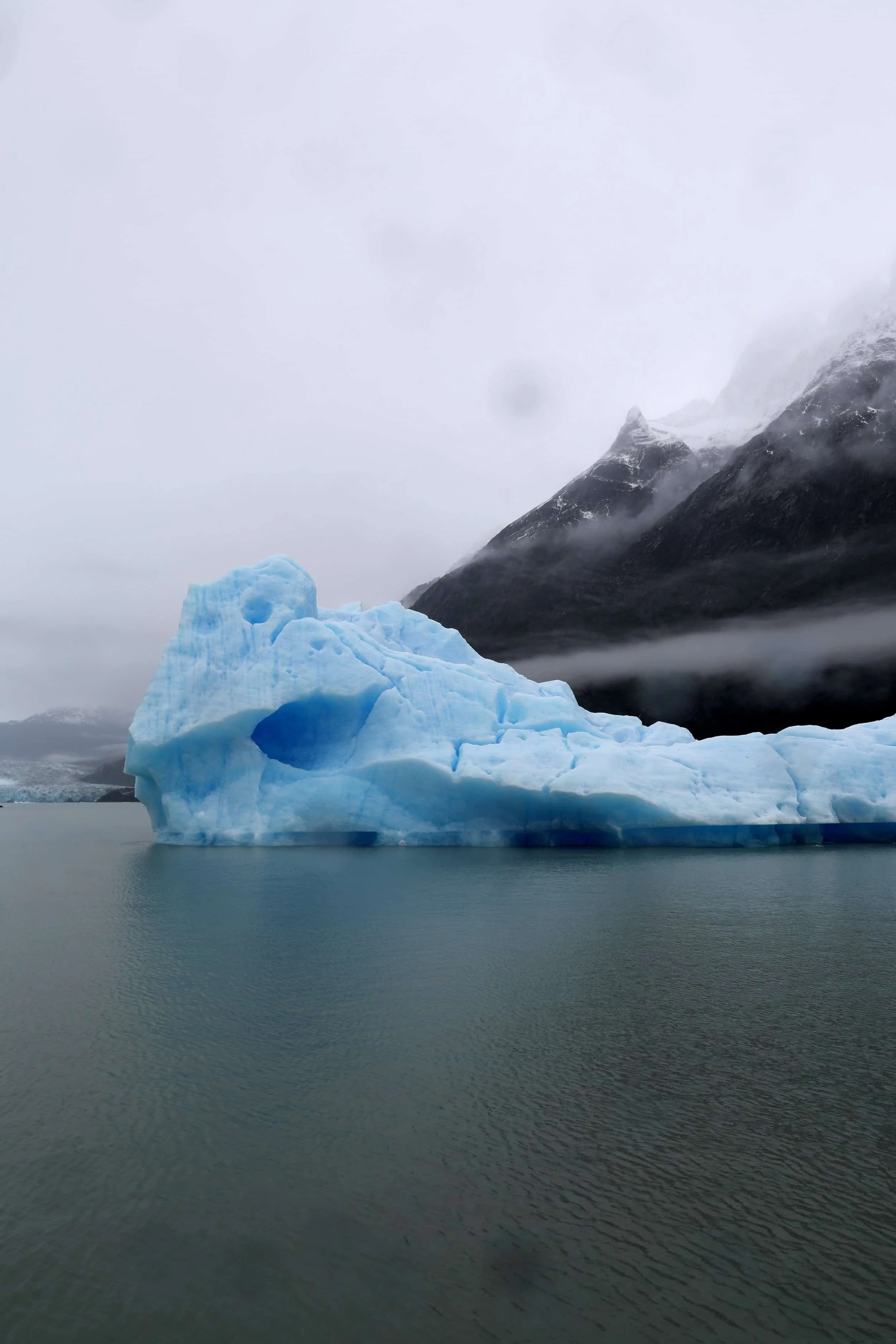



Fall in love with Hotel & Cava Estancia Rilán, a must-visit retreat where the setting becomes part of the stay and every detail quietly celebrates Chiloe Island.